

I built successful products for years before I understood the most important thing about them.
That’s the uncomfortable version. The cleaner version would be the redemption arc: I was clueless until I learned. That’s not what happened. The products shipped. We’ve been successful. The gap was somewhere else, and it took me years to see it.
The gap was between positioning as something marketing executes and positioning as something the product itself carries. I understood the first. I missed the second. The first is what marketing communicates. The second is what the product delivers. They sound similar. They aren’t.
Tommy Hilfiger broke the model for me.
The story is well-known but worth telling clean. In 1985 Tommy was a brand nobody had heard of. George Lois, the advertising mad man who launched the great success of Tommy's brand, put a giant billboard in Times Square. The headline read: The 4 Great American Designers For Men Are. Below it, four lines hangman-style: just the initial of each first name and surname, the rest of the letters blanked out. Three of the four were instantly solvable to any fashion-aware New Yorker. The fourth was the puzzle. The audience filled in the rest. He must belong in that company. Why else would he be on that wall?
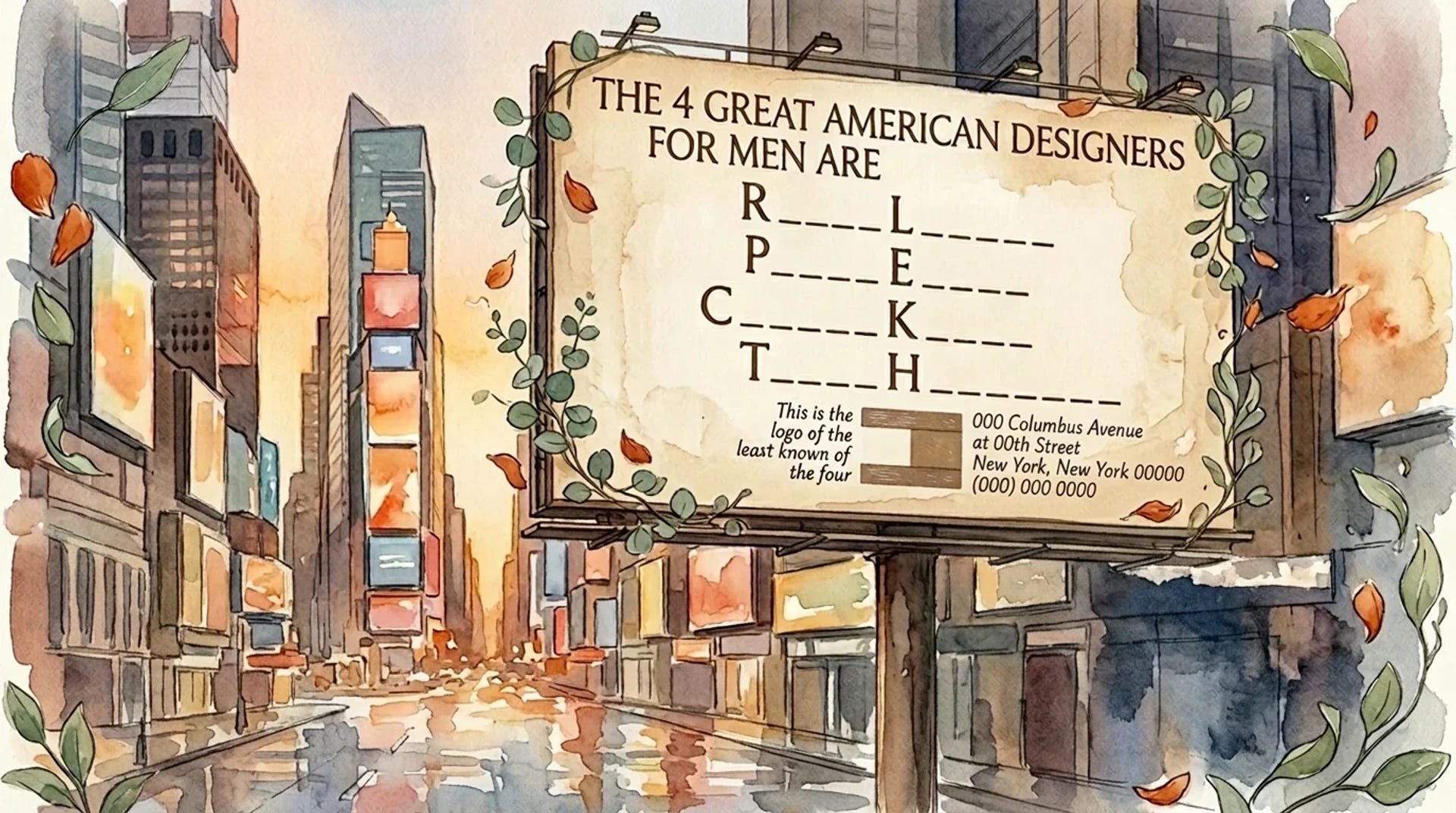
What they did was brilliant marketing. The move worked because of the order. Tommy set the category claim before the product was tested. The audience filed him correctly. Then the product had to confirm the claim on contact, and it did. The clothes were good, the price matched the category, the design held up. If the product had been weak, the borrowed club would have rejected him within a season. The billboard wasn’t a substitute for the product. It was a forcing function on the product. He had to deliver against the category he’d claimed, and he did.
Most builders ship the product first and hope the category sorts itself out. Tommy declared the category and made sure the product backed it up. That’s the reversal worth noticing. The category claim is the upstream commitment. The product either confirms it or breaks it. Marketing names what’s there. You can’t billboard your way into a category your product doesn’t carry. But you can declare the category early and use the declaration as a constraint on what gets built.
Abstract: The Art of Design cracked it open. Episode after episode showed designers (sneakers, graphic identity, architecture, type) building meaning into the object itself, not after. The meaning wasn’t accidental. It was decided at the desk. Later I realized this wasn’t new at all. Ries and Trout said the same thing in Positioning: The Battle for Your Mind in 1981, and it’s still uncomfortably accurate.
Their core claim is almost insulting. Positioning doesn't happen in the product. It happens in the mind of the prospect, before the product is tried. The mind has limited slots per category, usually one or two brands at the top, the rest invisible. You don't compete on what your product is. You compete on what slot it occupies in someone's head before they've ever used it.
You don’t compete on what your product is. You compete on what slot it occupies in someone’s head before they’ve ever used it.
Think about how you pick a hotel. You don't test five hotels and then choose. You form a perception: this one's a business hotel, that one's a romantic weekend, that one's where families go. You pick based on which category fits who you think you are. The decision is made before you've stayed anywhere. The stay does something different. It either confirms the category claim or breaks it. You either tell other people about it or you don't go back. The category claim got you in the door. The product determined whether the claim was true.
Positioning got right is what makes marketing and product compound. Positioning isn't about what you build — it's about the club you claim membership in. It creates comparison, not differentiation. It declares who you're allowed to be compared with, before others grant permission. Tommy didn't prove he was a top designer. He behaved as one. With the right positioning, the marketing puts the right prospect at the door and the product confirms the claim once they're inside. Marketing without good positioning is shouting in the wrong room. Product without good positioning is excellence nobody finds.
Then it landed:
Positioning isn’t marketing’s job. It’s the product builder’s job.
Here's why. The trade-offs that make a product mean something can only be made while the product is being built. Which features ship. Which features get refused. What the design language is. What's a default and what requires configuration. Each of those decisions is positioning, made by someone in Figma or in code. By the time marketing arrives, the decisions are already shipped. They can label what's there. They cannot go back and make it mean something it wasn't built to mean.
If you don't decide what your product means, the market decides. And market is often wrong. Not because the market is dumb. The market files your product in whatever category it most resembles, and the most-resembling category is rarely the one you'd choose. Default categorization is gravity. The only escape is having decided in advance.
Positioning isn't marketing's job. It's the product builder's job.
So are we mixing product and marketing together? Are they separate disciplines? Yes. They are. But meaning isn't a discipline-bounded concern. It's the upstream decision that determines what gets built and what gets cut. Whoever makes those decisions is doing positioning, whether they know it or not. The choice isn't whether to do it. It's whether to do it deliberately or by accident.
Positioning sets the question for your product, and gives engineering and design a chance to carry the answer.
The connection to operator work is direct. Judgment about what to build is inseparable from judgment about what it means. Same operator question. Same upstream call. AI can help you ship the answer faster than ever. It can't decide what question you're answering. That's still you.
The swap test. Take your product's positioning statement. Replace your company name with a competitor's.
If the statement still works, your positioning explains nothing. It should break the moment you change one element. If it doesn't, you don't have positioning. You have decoration.
In a later post I'll show what this looks like in practice — a product I love not for what it does, but for what wearing it says about me.
PS for the curious. Ries and Trout are where I started. They explain where positioning happens (in the prospect's mind) but not why some claims stick and others don't. The piece I had to add was Erdem-Swait on brand-credibility bonds: a positioning claim works when making it costs more than a weaker competitor could afford to fake. Without that costly signal, a positioning statement is just a slogan. More in a later post.
I agree with this strongly.
The key point for me is that “product builder” can’t mean only someone who decides features or ships functionality. In this context, the product builder also has to understand brand identity, communication, culture, and the lifestyle context of the audience.
That’s where positioning really becomes part of the product. Not as a marketing layer added later, but as a set of decisions that shape what the product means before anyone explains it.
AI may raise the baseline quality of execution. More products will become easier to build and technically good enough. But the advantage will still come from the people who can connect product decisions with meaning — who understand not only what the product does, but what it says about the person using it.
PS. The Abstract reference landed for me too. The Tinker Hatfield episode is such a strong example of product, identity, culture, and emotion becoming one thing - and still jordan's made by him are my favs