

AI doesn’t burn you out the old way. It burns you out in a new way - not from the work being hard, but from the work being so fast that you can’t stop.
I know this because I live it. The moment AI reduces friction between point A and point B, it feels like a teleport. You know exactly where you need to go, and suddenly you’re there. That’s the high. It’s genuinely exciting. And that excitement is the trap, because it’s 11pm and you think “just one more thing” and then it’s 2am and tomorrow is destroyed. I had to catch myself and actively correct this pattern to not end up there every night.
A new study by Boston Consulting Group, published in Harvard Business Review, confirms this isn't just me. They surveyed 1,488 workers and found something important: AI doesn’t cause traditional burnout. When AI replaces repetitive tasks, burnout actually drops 15%. But it causes something else: they call it “brain fry.” Mental fatigue from overseeing AI beyond your cognitive capacity. 14% of AI users report it. Those who do make 39% more errors, and are 39% more likely to want to quit.
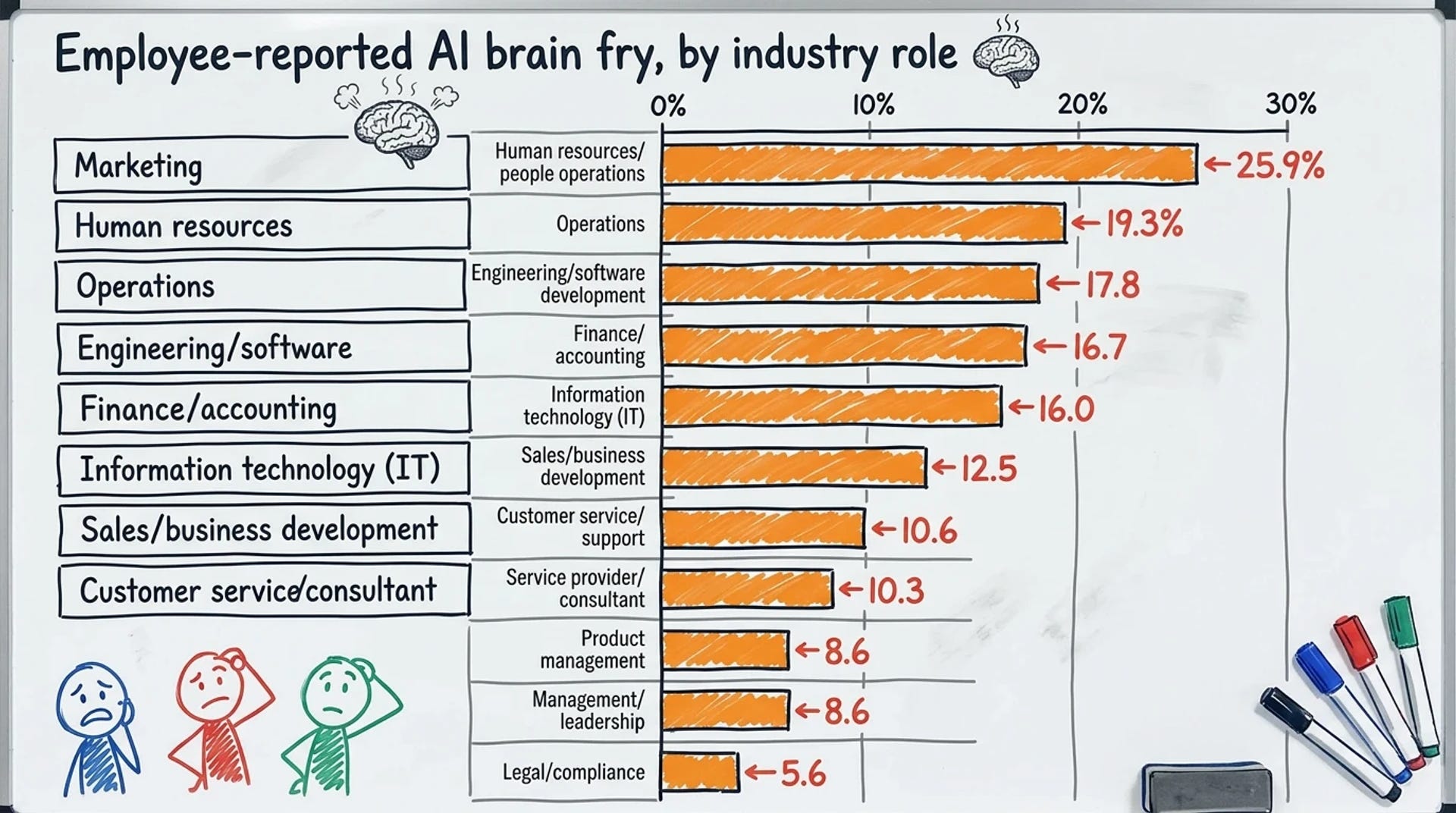
This distinction matters. Burnout is emotional exhaustion from bad work. Brain fry is cognitive overload from work that feels great but moves faster than your brain can process.
Here’s what I notice in my own workflow. There are two phases where AI feels completely different:
Phase 1: Definition. You’re defining what to build, what strategy to execute. AI helps you think, structure, explore. This is the teleport phase. It’s energizing because you’re planning, creatively building, making decisions. And AI is compressing the distance between the decision and the result.
Phase 2: Iteration. You’ve built something, now you’re improving it. Test, verify, adjust, get feedback from users, from the team. Iterate. This is where the trap opens - because between iterations, while AI is executing, you’re waiting. And you feel like you could do something more. So you start a second project. You switch to reviewing documents. You ask AI agents to run changes across different projects. You start sketching yet another product. And suddenly you’re context-switching between four or five different things and your brain melts.
The study suggests the number of tools is a key driver of fatigue. In my experience, that’s not the main factor. I regularly use 10+ tools on a single project and it doesn't fry me at all. What actually breaks me is switching between projects - each one requiring a different mental model.
AI doesn’t overload you because it’s complex.
It overloads you because it removes natural stopping points.
AI is executing, and you’re waiting. That gap feels like wasted time. So you start something else.
A second project. A document review. Another idea.
Now you’re not iterating - you’re context switching. And every unfinished thing stays active in your head.
That’s attention residue. That’s the Zeigarnik effect.
It’s not the work that overwhelms you. It’s the number of open loops.
(Sophie Leroy and Bluma Zeigarnik studied this long before AI made it everyone's daily experience.)
Every context switch is expensive - for you and for the AI. Think of it like an LLM on a GPU. You load the model, allocate memory, fill the context window. The agent knows your project, your documents, your workflow, your intent. Then you switch it to a different project and you dump all that state. Fresh session. Cold start. Now multiply that cost across your own brain. You’re doing the human equivalent of cold-starting a new inference session every time you switch tasks - except your brain also keeps ghost processes running from every previous session. Unlike a GPU, you can’t kill those threads.
What I've learned the hard way. Work in batches. One project at a time. When AI is executing and you feel the itch to start something else - write down the thought, capture it, but don't switch. The context in your head is as expensive as the context in the model. Protect both.
When you've lost track of what you were even trying to do - stop. Use AI to get yourself out. Ask it to summarize everything that's happening. Get the helicopter view. Rebuild your mental model from the top down instead of from the fragments.
Pick your battles for a given day, maybe even for a few days. Go deep on one thing only. The 20-mile march applies here: sustained focus on one thing beats sprinting across four.
And please - in between, don't add more articles, PDFs, and pages to your LLM wiki. Why would you do that to yourself. Your second brain will not replace your first. Go for a walk instead.
The irony is sharp. AI's biggest promise is removing execution bottlenecks. But the new bottleneck is attention - and unlike execution, attention doesn't scale.
Lovely read. That’s what the reality of today feels like - not the cool, confident calm of knowing a task is going to be done, but instead a constant slight strain as if your brain is weight lifting because there is a million things happening. I often wonder if people who are by their nature super focused struggle more in this environment. Myself, I go for a walk.